

Make-ahead Beef Wellington gets the trimming, cooking, and wrapping done before the day you serve it. I cook the tenderloin sous vide, sear it, brush it with Dijon, and wrap it with mushrooms, prosciutto, crepes, and puff pastry. Then the whole Wellington goes into the freezer with the pastry still unbaked.
On baking day, the oven has two jobs: bake the pastry, then gently warm the beef. This guide takes you through both.
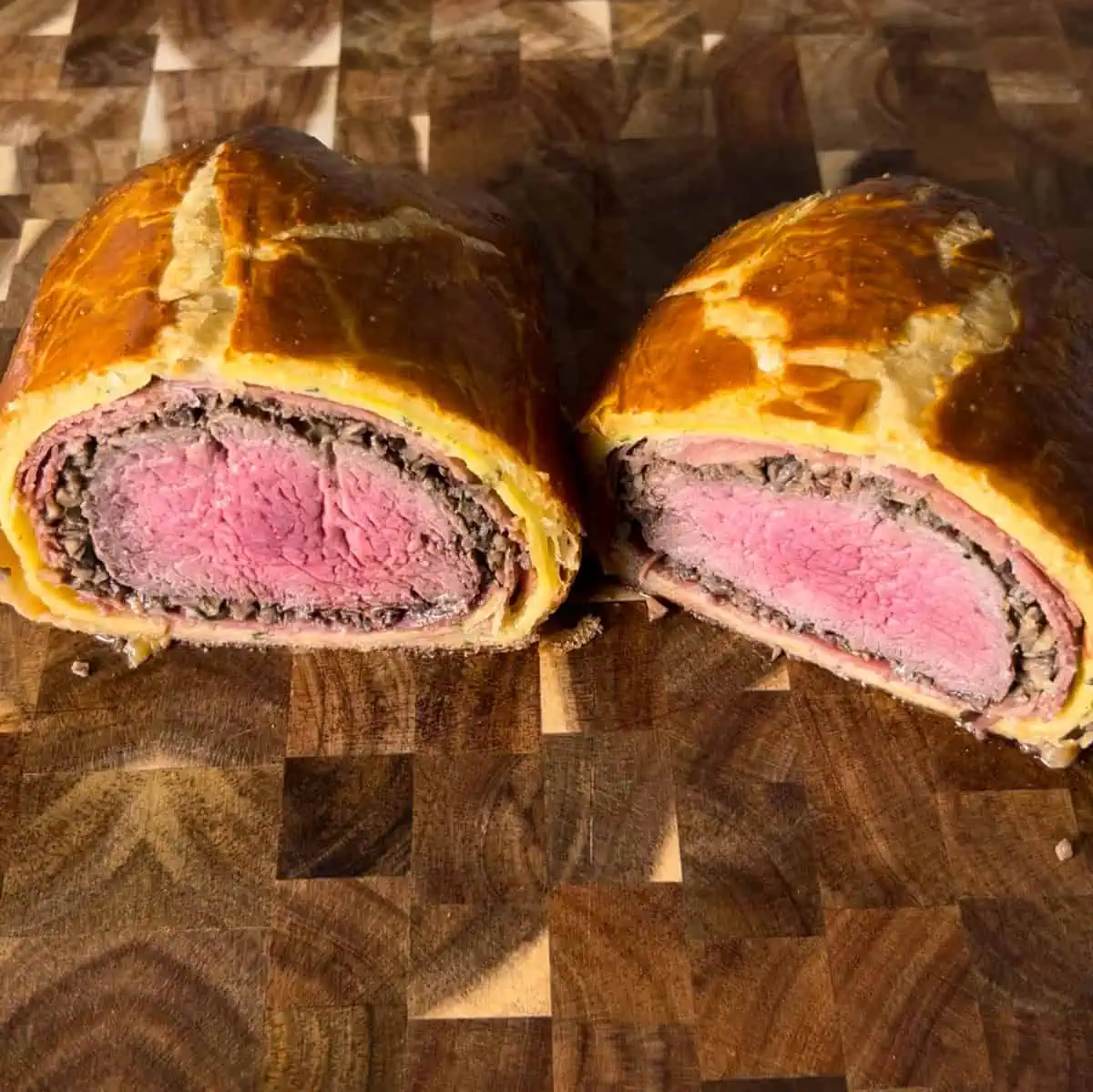
Before You Start
This method is for a whole Wellington made with sous-vide-cooked beef and unbaked pastry. A Wellington with a raw center, a store-bought frozen one, or already-baked leftovers each need their own directions — the FAQ at the bottom points you to the right place.
The freezer approach was inspired by Chris Young’s method. The Dijon, mushroom duxelles, prosciutto, and crepes come from my original Beef Wellington recipe.
- Plan ahead: allow 12–24 hours for dry-brining, then time for the sous vide cook, assembly, thorough chilling, and freezing solid. For best quality, freeze for up to 3 months.
- My tested bath setting: 130°F (54.4°C) for 2½ hours, with an even center-cut tenderloin no longer than 8–9 inches so it fits the pastry.
- Use a thermometer: oven times are estimates. You’ll check the center of the beef and monitor it through the rest.
About the temperatures: this method aims for a medium-rare finish. The 105°F oven-removal point below is a quality target, not a food-safety number — and earlier cooking doesn’t make later cooling and handling irrelevant. The USDA’s guidance for reheating cooked leftovers is 165°F.
Build a Christmas Dinner Around It
This is the freezer-ahead option for the Showpiece Table in my Christmas Dinner Game Plan. Cooking and wrapping the Wellington ahead gets the preparation out of Christmas Day. It still needs the oven for both the hot pastry bake and the low-temperature finish, so build the rest of the meal around that.
- Instant Pot: Mashed Potatoes with Evaporated Milk give you a creamy side without taking oven space.
- Stovetop: Sautéed Collard Greens cook in a skillet, leaving the Instant Pot for the potatoes.
- Made ahead: Peppermint Bark Cheesecake finishes the meal. Make and chill it before Christmas Day so its pressure-cooker session is already done.
An air fryer gives you room for Maple Bacon Brussels Sprouts, too; use that recipe’s air-fryer method for this menu. The potatoes and collards are enough if you want to keep the meal simpler.
Ingredients and Equipment
These are the ingredient quantities from my original Wellington. Have extra prosciutto, crepes, and pastry on hand if needed to cover your tenderloin.
Beef, Searing, and Wrapping
- An even center-cut beef tenderloin, trimmed for chateaubriand and no longer than 8–9 inches for this pastry setup
- Kosher salt for the dry brine; black pepper for seasoning the beef
- 2 tablespoons grapeseed oil for searing
- 2 tablespoons Dijon mustard, or enough for a thin coating
- 8 slices prosciutto, plus more if needed for overlapping coverage
- 1 sheet puff pastry, thawed as its package directs and kept cold; enough to enclose the filled roll at ⅛ inch thick
- Egg yolk as needed to seal the pastry edges
Mushroom Duxelles
- 2 tablespoons olive oil
- 16 ounces baby bella mushrooms, finely diced
- 1 teaspoon sea salt
- ½ teaspoon black pepper
- 1 teaspoon thyme leaves
Chive-and-Thyme Crepes
- 1 large egg
- ½ cup all-purpose flour
- ½ cup milk
- ½ teaspoon finely chopped chives
- ½ teaspoon thyme leaves
- ¼ teaspoon sea salt
- Cooking spray for the pan
Baking-Day Egg Wash
Whisk together 2 egg yolks and 2 teaspoons whole milk on baking day. This is separate from the yolk used to seal the pastry.
Equipment
You will need a sous vide circulator and suitable water container; a vacuum-seal bag or suitable zip-top bag; a rack and tray; cast iron and nonstick skillets; plastic wrap; a rolling pin; a pastry brush; freezer wrapping; and a metal baking sheet with parchment rated for 450°F.
Use an instant-read thermometer with a probe long enough to reach the center from one end. It’s for quick checks — pull it out before the Wellington goes back in the oven. Only an oven-safe leave-in probe may stay inserted. An oven thermometer helps confirm the temperature drop between baking stages.
Prepare and Freeze the Wellington
1. Trim and Dry-Brine
Remove the silverskin and tapered ends to leave an even center cut, no longer than 8–9 inches. Check that your pastry will wrap around the beef plus all the filling layers, with enough left to close the seam and ends.
Season the beef generously with kosher salt, set it on a rack over a tray, and refrigerate uncovered for 12–24 hours. It’s fully salted at this point, so don’t salt it again before searing.
2. Seal and Cook Sous Vide
I use a vacuum-sealed bag. A food-safe zip-top bag rated for sous vide works too: use water displacement to push the air out while keeping water away from the opening, then seal and clip the bag so the beef stays submerged with the opening above the waterline.
Heat the bath to 130°F (54.4°C). Add the bag, leave space for water to circulate around it, and cook for 2½ hours, starting the time once the beef is in the heated bath.
That timing is what I tested for this preparation. If you use a substantially larger cut, check appropriate sous vide timing guidance rather than assuming the same cooking time.
3. Make the Mushrooms and Crepes
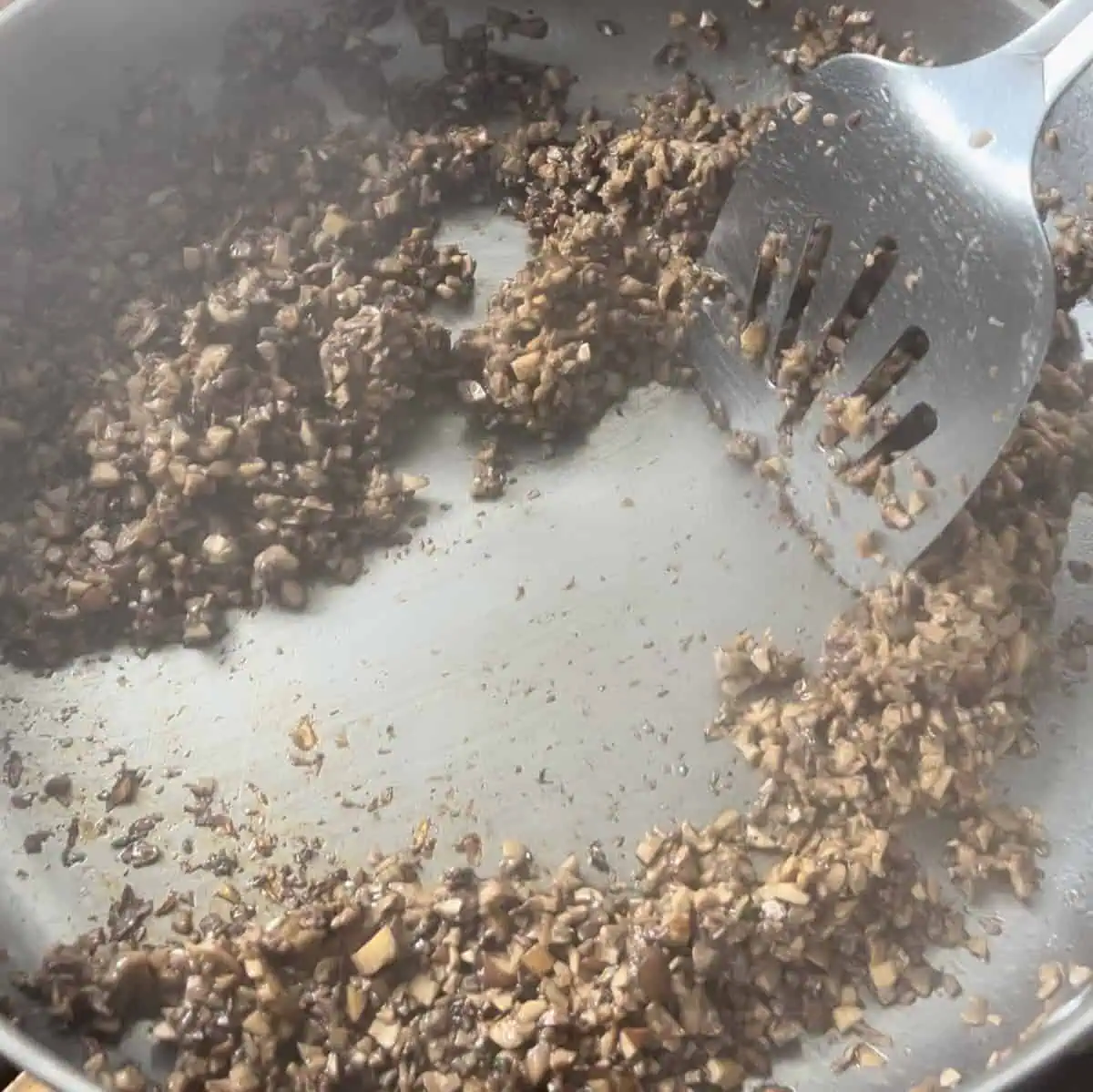
While the beef cooks, heat the olive oil over medium heat. Add the finely diced mushrooms, sea salt, pepper, and thyme. Cook until the released liquid has evaporated and the pan looks dry. Spread the duxelles in a shallow container and refrigerate promptly to cool.
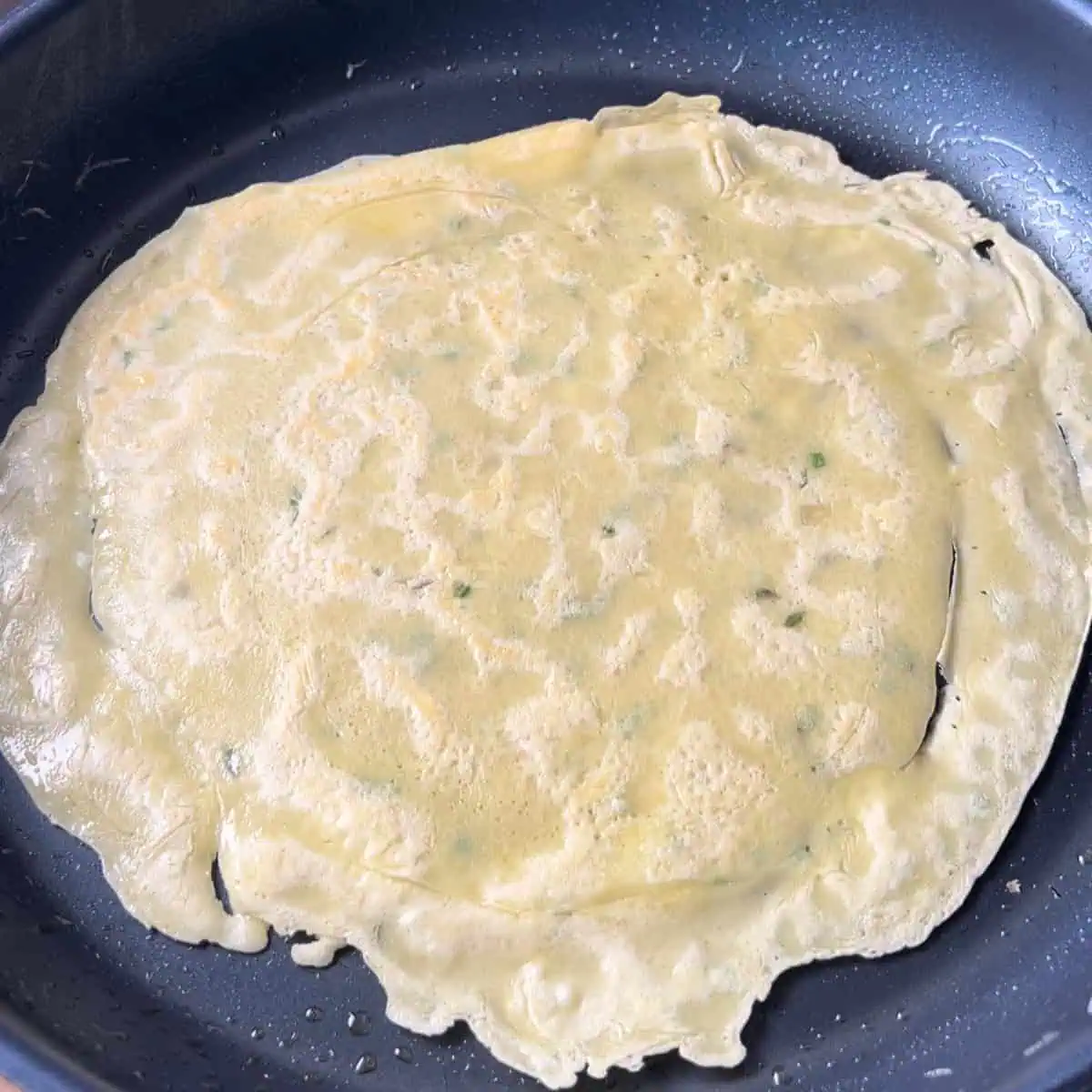
For the crepes, whisk the egg, flour, milk, chives, thyme, and salt until smooth. Refrigerate the batter for at least 30 minutes. Heat a nonstick skillet over low heat and lightly coat it with cooking spray. Add about ¼ cup batter and swirl it into a thin layer. Cook until just set, about 25–30 seconds, then flip for a few more seconds.
Keep the crepes thin and pale, and let them cool before wrapping. You need enough to cover the filled roll with a slight overlap; my original assembly uses two trimmed crepes.
4. Sear, Brush with Dijon, and Chill
Remove the tenderloin from the bag and pat it thoroughly dry. Season with black pepper. Heat a cast iron skillet over high heat, add the grapeseed oil, and sear every side, including the ends, for about 60 seconds per side.
Transfer the beef to a clean tray and brush it with Dijon immediately, while it’s still hot.
Refrigerate the beef on a clean tray for about 20–30 minutes — long enough that it won’t warm or soften the puff pastry when you wrap it. The mushrooms and crepes should be fully cool by now, too.
5. Build the Inner Wrap
Moisten the work surface with a damp towel and lay down overlapping sheets of plastic wrap. Arrange trimmed crepes on the plastic, then overlap the prosciutto on top. Spread the cooled duxelles evenly over the prosciutto and place the mustard-coated beef on the filling.
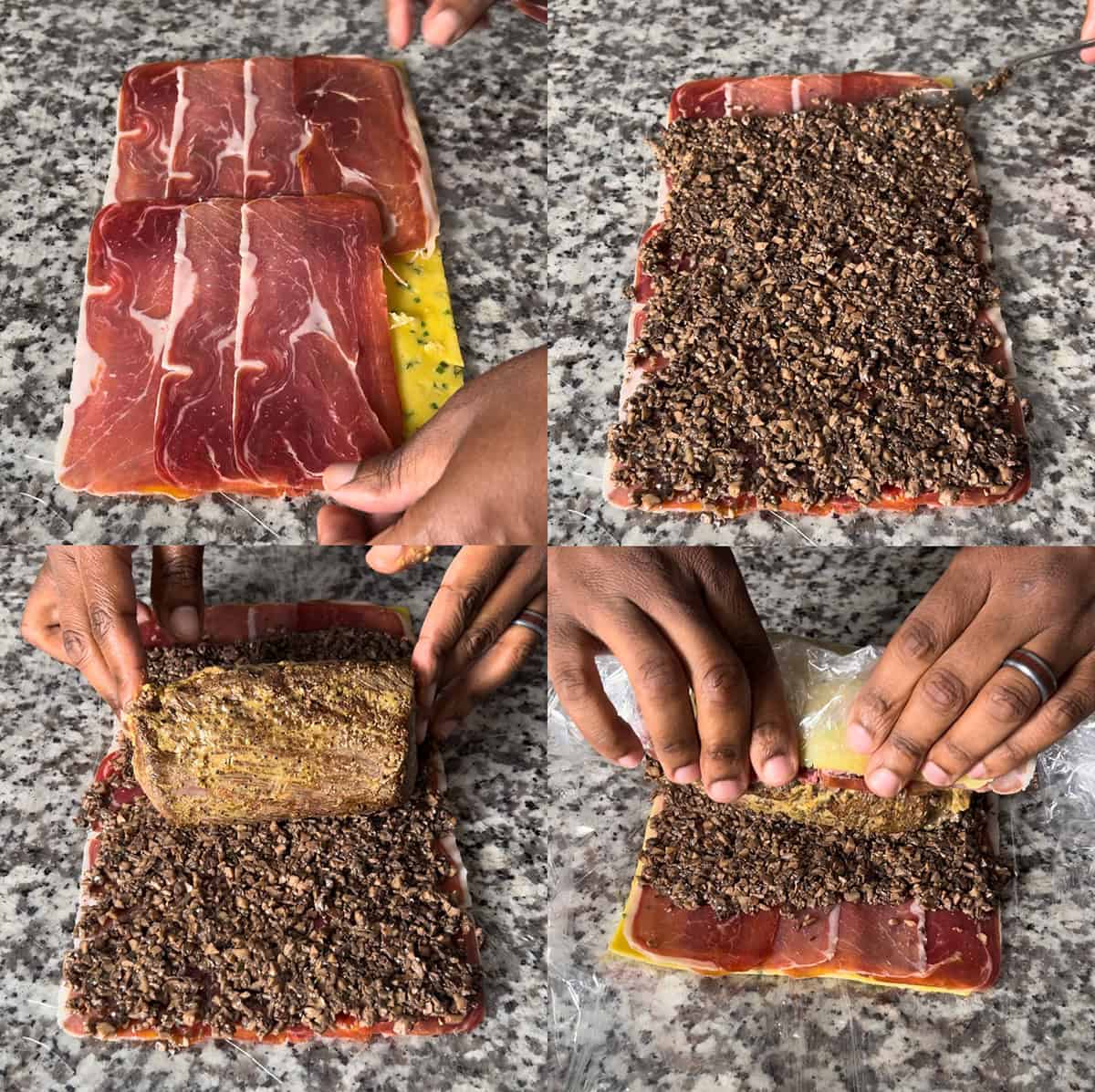
Use the plastic to roll the layers snugly around the beef. Twist the ends to hold the cylinder together, then refrigerate for at least 20 minutes to firm the shape.
From the center outward: beef, duxelles, prosciutto, crepe, then puff pastry.
6. Add the Pastry and Freeze
Roll the cold puff pastry into a rectangle about ⅛ inch thick, large enough to enclose the cooled filled roll. Remove all the plastic from the inner wrap. Place the roll lengthwise on the pastry, brush the edges with egg yolk, and wrap it snugly. Seal the ends and keep the seam underneath.
Use fresh plastic wrap to hold the shape and refrigerate for about 30 minutes to firm the pastry. Save the exterior egg wash for baking day.
Add protective freezer wrapping or a freezer bag, label it with the date, and place it seam side down on a flat tray. Freeze solid before baking. One note: check your puff pastry package — some brands advise against refreezing after thawing.
At this point the beef has been cooked sous vide and the pastry is still unbaked. Keep the Wellington frozen until baking day.
Baking from Frozen
Start with the Wellington prepared above: beef cooked sous vide, pastry unbaked, and center frozen solid.
1. Preheat and Egg-Wash
Preheat to 450°F. Remove every layer of freezer wrapping and put the Wellington seam side down on a metal baking sheet lined with parchment rated for that temperature. Use the lower-third rack.
Let it sit out while the oven heats — about 20–30 minutes — while you apply the egg wash. This takes the hard chill off the pastry surface; the center should still be frozen.
Whisk the 2 egg yolks and 2 teaspoons whole milk together, and brush a thin, even coat over the exposed pastry.
2. Bake the Pastry
Bake until the pastry is well risen, deeply golden, and crisp. My timing range is 30–45 minutes with convection or 40–60 minutes in a conventional oven. Rotate the tray as needed for even browning.
Start checking at the early end of the range, and judge by the pastry, not the clock. If the top browns faster than the sides, shield it loosely with foil while the rest catches up.
3. Lower the Oven Temperature
Take the Wellington out while you drop the oven to 150–170°F. Opening the door briefly speeds the cool-down — turning the dial down doesn’t vent the heat that’s already inside, so give it a few minutes and check before returning the tray.
This finish depends on an oven that can hold that low setting. If yours runs hotter, the beef will warm faster and carry over further, and the timing and removal point below won’t behave the same way.
4. Gently Warm the Center
Check the center with an instant-read thermometer inserted lengthwise through one end. Put the tip in the middle of the beef, not in the mushroom layer. Don’t force the probe into an icy center — if it won’t enter smoothly yet, keep warming in the low oven and check again shortly.
Remove the handheld thermometer, then return the Wellington to the low oven. I take mine out at 105°F in the center. Warming takes roughly 45 minutes, but the thermometer decides: once the center passes 80°F, check every 10 minutes, and more often as it nears the target.
If the center has already reached 105°F when the pastry finishes, skip further warming and move to the rest. An oven-safe leave-in probe can monitor continuously if it’s positioned correctly and used within its manufacturer’s limits.
5. Rest, Monitor, and Slice
At 105°F, remove the Wellington from the oven. If juices have collected on the tray, use two wide spatulas to transfer it to a dry cutting board so the bottom doesn’t sit in liquid.
Rest for 10–20 minutes and keep checking the center. The intended finish is about 130°F, but a 25°F rise isn’t guaranteed — the cut, the oven, and the temperature differences inside the Wellington all affect carryover.
If the center stalls below the finish you want, return the Wellington to the low oven and check frequently. Pull it before the center reaches 130°F and monitor through another short rest so it doesn’t overshoot.
Slice thick with a sharp knife — a serrated edge helps through the bottom crust — and serve promptly. Heads up: end slices run heavy on pastry and filling, so save them for the crust-lovers at the table.
Make-Ahead Timeline at a Glance
- Up to 3 months ahead: trim, dry-brine overnight, cook sous vide, assemble, wrap, and freeze.
- Serving day: allow about 2½–3 hours before dinner for preheating, egg-washing, baking, warming, and resting. Bake at 450°F until the pastry is deep golden, then lower the oven to 150–170°F and warm the center to 105°F.
- Just before serving: rest 10–20 minutes while carryover brings the center toward 130°F, then slice.
For the Christmas menu above: make the cheesecake the day before. Cook the potatoes and collards while the Wellington bakes and warms, then use its rest to finish the sides and get ready to serve.
Storage and Common Questions
How long can it stay in the freezer?
For best quality, freeze for up to 3 months. Wrap the Wellington well, label it with the date, and keep it frozen at 0°F or below until baking day.
Can I use this method for a store-bought frozen Wellington?
Follow the package directions. Its size, filling, and whether the beef was cooked before freezing may all differ from this preparation.
What if I want to make Wellington without sous vide?
Use my original Beef Wellington recipe. That version sears the beef before assembly and cooks its center during the oven bake — don’t apply the 105°F removal target above to a raw-centered Wellington.
Do I have to buy a vacuum sealer?
No. A suitable zip-top bag works too. See the sous vide step for choosing the bag and sealing it with water displacement.
What about leftovers?
Refrigerate leftover slices in shallow, covered containers within 2 hours, or within 1 hour if the temperature is above 90°F. Keep the refrigerator at 40°F or below and use within 3–4 days. Reheat leftovers to 165°F, checking with a thermometer. The low-temperature frozen finish above is not a leftover-reheating instruction.
The trimming, cooking, and wrapping are already behind you. Finish the sides while the Wellington rests, then slice through the crisp pastry and bring it to the table.


Leave a Reply