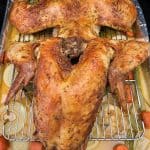
Frog-Style Turkey with a 48-Hour Dry Brine
A 12–14-pound turkey dry-brined whole for 48 hours, opened frog-style with the backbone retained, and oven-roasted at 425°F.
Servings 12 servings
Equipment
- Sturdy kitchen shears
- Large cutting board
- Rimmed sheet pan with oven-safe wire rack
- Instant-read thermometer
Ingredients
Turkey
- 1 whole turkey 12–14 pounds; unbrined and fully refrigerator-thawed
Dry Brine: Salt (Choose One)
- 3 ½ tablespoons Diamond Crystal kosher salt use this OR the Morton's option below, not both
- 2 tablespoons Morton's kosher salt use this instead of Diamond Crystal, not in addition to it
Dry Brine: Remaining Ingredients
- 2 teaspoons baking powder not baking soda
- 1 tablespoon garlic powder
- 1 tablespoon onion powder
- 1 tablespoon dried thyme and rosemary any combination; use the listed amount in total
- 2 teaspoons smoked paprika
- 1 teaspoon ground sage
For the Roasting Pan
- 3 large carrots cut into large chunks
- 4 celery stalks cut into large pieces
- 2 yellow onions thickly sliced
- 2 garlic heads halved crosswise
- 3 sprigs fresh rosemary
- 6 fresh sage leaves
- 6–8 sprigs fresh thyme
- 1 cup chicken broth
- lemon thinly sliced; optional
Optional Skin Coating
- 3 tablespoons bacon fat melted; use enough for a thin coating before roasting
Instructions
- Whisk together the dry-brine ingredients, using the amount listed for your chosen salt brand. Use only one of the two salt options. Break up any baking-powder clumps. Remove the neck, giblets, packaging, and any leg restraint from the fully thawed turkey. Pat the skin dry.
- Spread the mixture evenly over the outside skin of the breast, legs, wings, and back. Do not put seasoning under the skin. Place the whole turkey on a rack over a drip-catching tray and refrigerate uncovered at 40°F or below for 48 hours. If starting with a frozen turkey, thaw it completely in the refrigerator first; those thawing days are separate. The 48-hour brine counts toward the 1–2-day refrigerated holding window after complete thawing or after purchasing a fresh turkey.
- On a large, stable cutting board, start at the cavity opening between the breast and one thigh. Cut along that side toward the neck through the ribs with sturdy kitchen shears. Repeat on the other side. These cuts let the breast section hinge open while staying attached near the neck. Fold the breast section away from the back and legs, snipping any remaining ribs or tissue that prevent it from opening. Keep the breast attached at its hinge and leave the backbone in place. Turn skin-side up and press the breast and each thigh flatter, spreading the leg section away from the breast. Tuck the wing tips under the breast, or snip them off at the joint, to keep them from scorching.
- Preheat the oven to 425°F and position a rack with room above the turkey. Line a sturdy rimmed sheet pan with foil. Add the carrots, celery, onions, garlic, and fresh herbs, plus optional lemon slices for more flavorful pan drippings. Pour in the chicken broth. Set an oven-safe wire rack over the aromatics and place the turkey skin-side up on it. If desired, brush the skin lightly with the melted bacon fat just before roasting.
- Roast at 425°F throughout. Begin checking at 90 minutes and plan on about 105 minutes of roasting. Turkey is safe at 165°F. For more tender dark meat, I prefer taking both leg quarters to 180°F, measured with an instant-read thermometer in the innermost thigh without touching bone. Also check the thickest part of the breast and the innermost wing on both sides; they should each reach at least 165°F. The thermometer determines doneness. If the pan liquid evaporates and the aromatics begin to scorch, add a little broth to the pan without wetting the skin.
- Transfer to a carving board and rest for 20 minutes. Separate the leg quarters and wings at their joints. Remove the breast halves from the breastbone and slice across the grain. Separate thighs from drumsticks if desired, then serve.
Notes
Herbs: The thyme and rosemary share one combined amount in the ingredient list; do not use that amount of each herb. Fresh herbs and vegetables in the pan are flexible estimates.
Time: Total time includes 15 minutes of hands-on prep, the 48-hour dry brine, approximately 105 minutes of roasting, and a 20-minute rest. Allow about 3–4 days of refrigerator thawing before the brine if starting with a frozen 12–14-pound turkey.
Pre-brined bird: Skip the full dry-brine mixture, including the salt and baking powder. Air-dry the fully refrigerator-thawed bird uncovered on a rack over a tray in the fridge at 40°F or below for 24 hours. For each 12–14-pound bird, add 1 tablespoon total dried thyme and rosemary plus 1 teaspoon ground sage before roasting. That air-drying day counts toward the safe refrigerated holding period after thawing. Then follow the same frog cuts, roasting steps, and thermometer checks.
Servings: One 12–14-pound turkey provides about 12 generous main-dish servings or up to 20 smaller portions alongside plenty of sides.
Multiple turkeys: The multiplier is for additional 12–14-pound birds, not one larger turkey. Use the scaled ingredient list, and check each bird separately for doneness; cooking time does not multiply with the ingredients. A larger single bird needs more pan space and a longer roast; the seasoning amounts and timing here are for 12–14-pound birds.
Bacon fat: Optional; brush a thin layer over the skin just before roasting.
Leftovers: Refrigerate carved turkey in shallow containers within 2 hours, use within 3–4 days or freeze, and reheat to 165°F.